Showing posts with label manners. Show all posts

Tuesday, January 31, 2012

Because some things do get lost in translation


Happy New Year! Gong Xi Fai Cai! 祝贺大家龙年龙马精神,万事大吉!


Chinese New Year has always been one of my favourite times of the year. This is our second year with Dear Daughter in tow. And I have to say - things do get betterI had a fabulous CNY.


1. For one, being with our parents and the huge extended family means I have two hands to myself. This is something which they don’t warn you of in parenting books. Have a baby and learn to do everything with one hand.

2. I am able to savour the endless rounds of good food in peace. No gobbling an entire meal in two or three bites or chasing after a toddler in between stuffing myself with mouthfuls of food.

3. DD runs around entertaining our family members. Her joy is infectious and it is great to see others loosen up with her and laugh along. This is the year she gets very interested in dogs. It cracked us up when she stands at the door beckoning the family dogs to come over with, ‘Dog! Come here!’

Guess what she saw? 
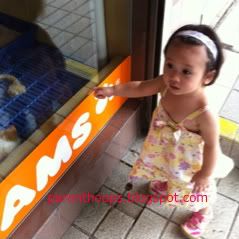
Aww, lovely puppies which are as excitable as she is. Too bad condos in KL can't keep dogs.

4. I taught DD to do the ‘gong xi’ pose, the one where you put both fists together and shake vehemently as a symbol of congratulations. Children at this age learn quickly through mimicking adults (yes, that’s why we are role models). DD saw DH and I offering two mandarin oranges to our elders and copied us by bringing mandarin oranges to her grandparents. It heartens me.

It is very important to me that DD is exposed to the Chinese traditions. I want her to learn to greet her elders, to wait till the elders eat before she can start. I want her to know not just Mandarin but also her dialects.

After living in Hong Kong for a couple of years and covering the North Asia markets, I am convinced that knowing Mandarin is mandatory and basic, knowing the dialects is the next wave of advantage.

I remember when I first started out doing sales, my boss who was the Head of Sales told me that ‘D, clients don’t buy from you because you have the best product or best price. People buy from people they like.’ It’s true, and usually speaking the local language helps break the ice and brings people closer. The benefits of knowing languages are intangible but very real.

Unfortunately for the younger generation, they are generally exposed to English only and deprived of the opportunity to learn dialects. Here in KL, it’s pretty bad. From primary level, we would be forced to choose between going completely Chinese, completely Malay or pay through the nose at an international school. At the all important early childhood stage, there is a dearth of options.

Yes, many kindergartens claim to teach Mandarin. But you don’t pick up a language unless you are immersed in it. Allow the child to interact in the language so that his/her brain forms the right synapses. The system our school uses alternates between English and Chinese weeks, allowing full bilingual immersion and have successfully produced batches of effectively bilingual children since 1998. This is why I went through the drastic measure of importing a system.

Having said that the best way to learn a language is not through a taught environment but rather in everyday life. For DD, I speak to her in English, Mandarin and Cantonese. Occasionally we learn Japanese together (I studied years of it but don’t remember most of it since I have not used the language in years). When my parents are here, I ask them to speak to her in Hokkien as well.

Initially my parents resist here fearing it would make them ‘uncool’. I had to laugh when I heard this. This coming from my strict traditional dad. After I explained to them my rationale, my dad agreed that imparting her with dialect skills is an invaluable gift.

He questioned then if it would be confusing for DD to be exposed to so many languages at a tender age. I explained to him that when children are under three, their ability to absorb information is tremendous. Just expose them to the languages actively (ie. not passively through a DVD and hope for the best) and the little seeds are planted in their brains. You will be surprised how kids pick up the nuances of languages almost instinctively.

At the end of the day, the most important thing to me is that DD is happy. I will provide her a nurturing environment to acquire knowledge and skills in a fun way. A good foundation in early childhood serves as a springboard to realizing her full potential. After this, it’s up to her how far and high she wants to fly.

Monday, January 9, 2012

How to select a preschool/nursery/daycare

Over the course of last few weeks, I have got two friends asking me how to select a preschool for their children.
One’s not based in KL (or I would have asked you to send your child to my school dear) and the other friend’s child is under one year old. So I thought I will write an entry for all parents who are looking for a preschool/kindergarten/nursery/daycare.
I would like to pat you on the back for deciding to send your child to any form of formal learning setting.
A child is born with a tremendous ability to learn. Do you know that a child’s brain is 97% developed by the time he/she is 6 years old? Their brains grow and create new synapses through new learning experiences. Hence, the more you stimulate your child during the early years, the greater the learning potential your child might realize.
Firstly, consider the amount of exposure for your child and weigh it against your current arrangement. Perhaps you would your child to be placed in a learning environment all day while you work – Full Day. Or you have suitable care arrangement at home and only want a half day school – Half Day.
Once you have decided on the frequency of classes, here’s some other factors to consider in selecting a school:
1.Curriculum
This is the approach the school bases its curriculum on. It not only serves as a guide on how they run the school but also sets the syllabus for teaching content.

The most commonly heard of school of thought is Montessori, but many parents do not realize what Montessori philosophy entails. Maria Montessori recognizes that each child has great learning potential but learns at his/her own pace.

A newer school of thought is the WholeBrain learning system which is a science/logic based approach. WholeBrain learning believes that all babies are born geniuses and we just need to unlock their potential with appropriate stimulation of both left and right brains.

My ideal school is one which offers good curriculum that stimulates the right and left brains, a conducive environment for languages (English, Mandarin and Malay) and promotes social interaction.

2.Values System
No doubt as parents, you are most qualified to instill the right values in your child. But as your child spends a considerable amount of time in school, it’s important to choose one who shares similar core values as you.

For instance, I once interviewed a daycare whose principal thought that infants are ‘too young to know anything. When they grow older, then we teach them stuff.’ Uh huh no.

At our school, we teach our children the value of money, manners,  social graciousness and how to be a helpful contributing person.

3.Diet
You are what you eat. A good diet is especially important for very young children. As a child’s body undergoes tremendous amount of growth in the early years, what he/she eats has a strong impact on his/her physical growth.

Unfortunately, in KL, many schools feed our children processed food loaded with sugar or a porridge based diet high on simple carb but low on nutrition.

Child nutrition expert Patrick Holford said that many children are misdiagnosed with ADHD and dyslexia. A simple change in diet to include brain food affects the development of the brain and the child’s learning ability.

A good diet should consist plenty of good fat, complex carb, protein, calcium, fruits and vegetable. At our school, we have an in-house nutritionist who dedicates a huge amount of time and research into designing our menu. We also supplement our children with multi-vitamins and DHA (subject to parental sign-up).

4.Environment
Is there ample space for the child to roam? We want our kids to grow up in a ‘free range’ environment, not cooped up in a small hole all day.

Scrutinize the level of hygiene. If the school does not practice good hygiene, your child is more likely to fall sick.

Safety is something that Malaysians cannot take for granted. At our school, our security is enhanced with secure tag entry and regular patrolling provided by the building.

5.Convenience
This is a factor that tends to be overlooked. You don’t want to have to park, climb a flight of stairs yanking a stroller and struggle every morning just to get your child to work.

Instead, look for a school near your home with convenient drop-off points. If they are indoor, make sure they have escalators and lifts for accessibility. You will thank yourself when school starts.

6.Rules
The school should have a rule books and adhere strictly to it, such as sick child policy and designated eating area etc. Children thrive in a structured environment.

7.Honesty and Openness of the School
Have you ever encountered schools who will only meet you if you place an appointment? Or schools who are hesitant about parents observing sessions?

Schools which operate in a secretive manner may have something to hide.

Go with your intuition (yes, your innate mommy’s and daddy’s instinct) on the sincerity of the staff. Are they child-centric and genuinely care about your children? Is your child comfortable and happy?


I always recommend dropping in spontaneously when scouting out a school. If the principal or teacher is unable to give you the full attention then, they can arrange a follow-up full visit.

8.Involvement of parents
Personally I like to know what and how my child is doing in school. Parents would know how hard it is to find out from the kids themselves.


We hold regular meet-the-parents session to update them about their child, give an educational talk on a specific topic (right brain activity, diet) or engage their feedback in general. We are your partners in educating your children and it’s a two way process.

9.Licensing
There are an appalling number of preschools, daycares and nurseries in Malaysia without license. It’s not expensive nor complicated to obtain one. If the school scrimps on a small fee to avoid registration, consider what else they are scrimping on in educating and caring for your child.
 * *
Remember, each child is different and it’s important to find a school which fits your child’s personality and your family. Doing the homework in finding the right school for your child does reap its benefits. For one, your little one will look forward to going to school everyday and meet his/her teachers and friends.
At the end of the day, all we want is our child to be happy, healthy and balanced.